Our evolution
For decades, our investment experts have been designing portfolios using a multi-manager approach to help investors achieve their goals. MLC Asset Management’s investment team pioneered the multi-manager investment model in Australia over 35 years ago and IOOF’s team has received numerous industry awards for their multi-manager expertise.
The coming together of the investment teams of IOOF, MLC and ANZ Pensions and Investments, under the MLC Asset Management banner, has increased the depth and breadth of investment experience, knowledge, and resources working for our clients, and magnified our expertise in multi-manager investing.
Today we are proud to be one of Australia’s largest investment managers with over $148 billion* in assets under management. Our focus is to provide our clients with a contemporary range of high conviction, best-in-class, investment strategies and we have more than 45 investment professionals** applying their experience, knowledge and judgement to deliver consistent performance for our clients.
Investment philosophy
These beliefs guide our decision making and are central to how we construct our portfolios and bring the best of our investment thinking to our clients.
We believe:
- a great culture is the foundation for great investing
- active management adds value
- skilful diversification delivers over the long-term
- intelligent risk taking is a must
- the long-term matters but we remain agile
Our Chief Investment Officer, Dan Farmer, explains our Investment Philosophy.
An introduction to investing
The principle of saving is well known. Money is put away in a savings account or term deposit, generally achieving a fixed rate of interest with minimal risk.
Unfortunately, a savings account can offer returns little better than inflation. In real terms, that means you may end up losing money on your initial investment.
Investing, on the other hand, is the commitment of money today which, with an appropriate level of risk, comes with the expectation of realising your future financial goals.
It's about making your money work harder for you than just saving alone can!
This guide aims to build your understanding of the fundamentals of investing and helps get you started on the path to securing your financial independence.

Getting to know investments
What is an asset class?
Asset classes are different investment categories and are the building blocks of an investment. The main asset classes are shares, property, fixed interest and cash.
Australian Shares
Australian shares are shares in companies listed on Australian stock exchanges. Shares or stocks are securities representing ownership in a company. When companies distribute profits (via dividends), the investor receives part of it and often Australian companies partially or fully pay the tax payable on company income (franking).
Global shares
Global shares are shares listed on international stock exchanges. Global shares can have the additional risk of movements in the value of the Australian dollar against foreign currencies. Changes in exchange rates will change the Australian dollar value of Global shares. Fund managers can use strategies called derivatives to ‘manage’ investments against adverse currency movements.
Listed Real Assets (Property)
Property can include investments in listed property trusts (LPT) and other property securities. LPTs invest in a range of residential and commercial property, office buildings, hotels and industrial properties. LPTs are pooled property investments which are broken into units and listed on the stock exchange like shares in a company.
Fixed Interest
A fixed interest investment is a debt security issued by a bank, corporation or government in return for cash from an investor. The issuer of the debt is effectively a borrower and is required to pay interest on the loan for the life of the security. Fixed interest investments are valued on a mark to market basis, and as a result, their value may fluctuate. Fixed interest investments are generally higher risk than cash but lower risk than shares and property.
Cash
Cash funds are designed to offer a high degree of capital security relative to other asset classes. Generally, cash investments have a very low risk of capital loss. Examples include bank deposits and investments in fixed interest securities, including treasury notes and highly rated corporate debt securities which generally have a maturity of less than one year.
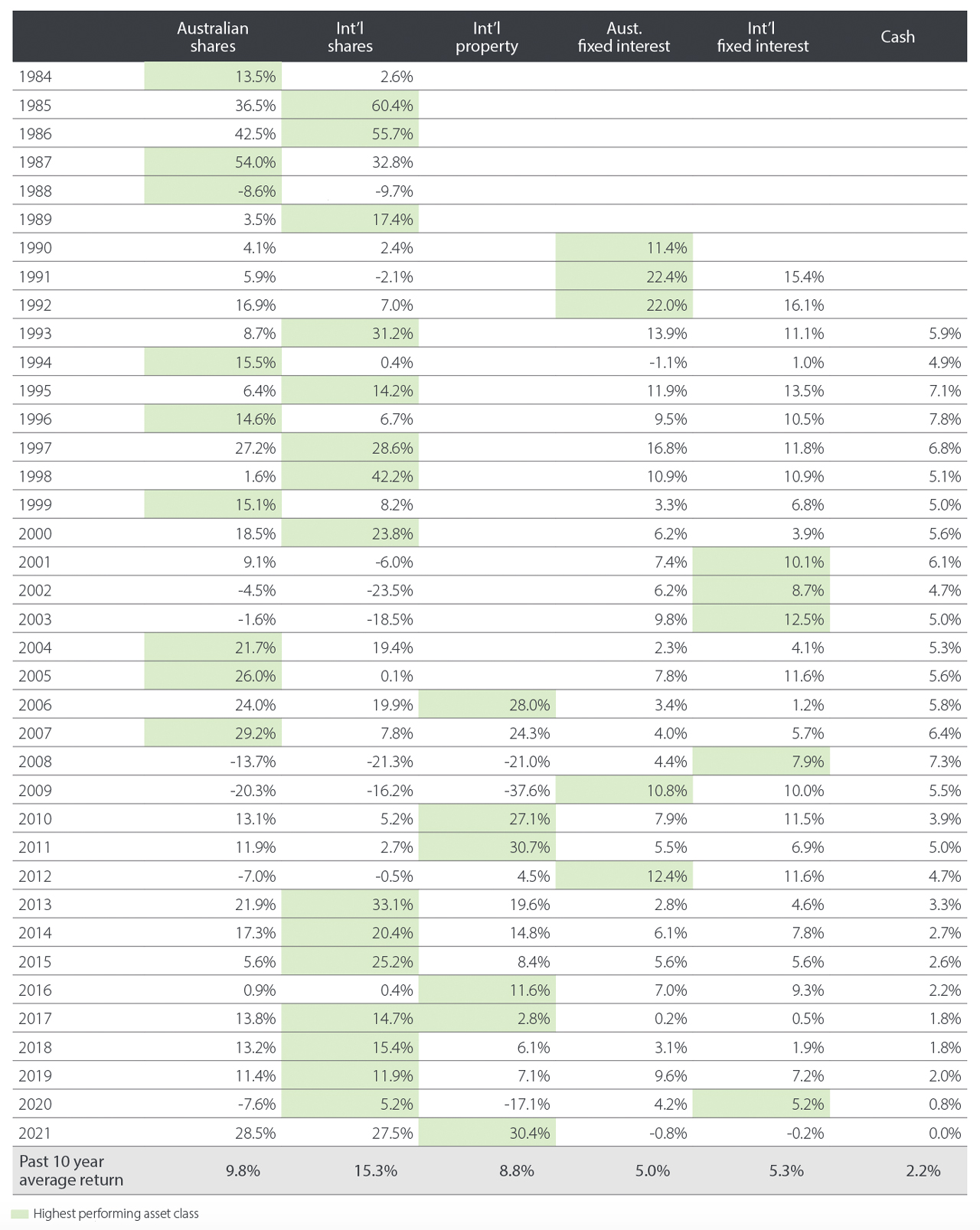
Key asset class performance^
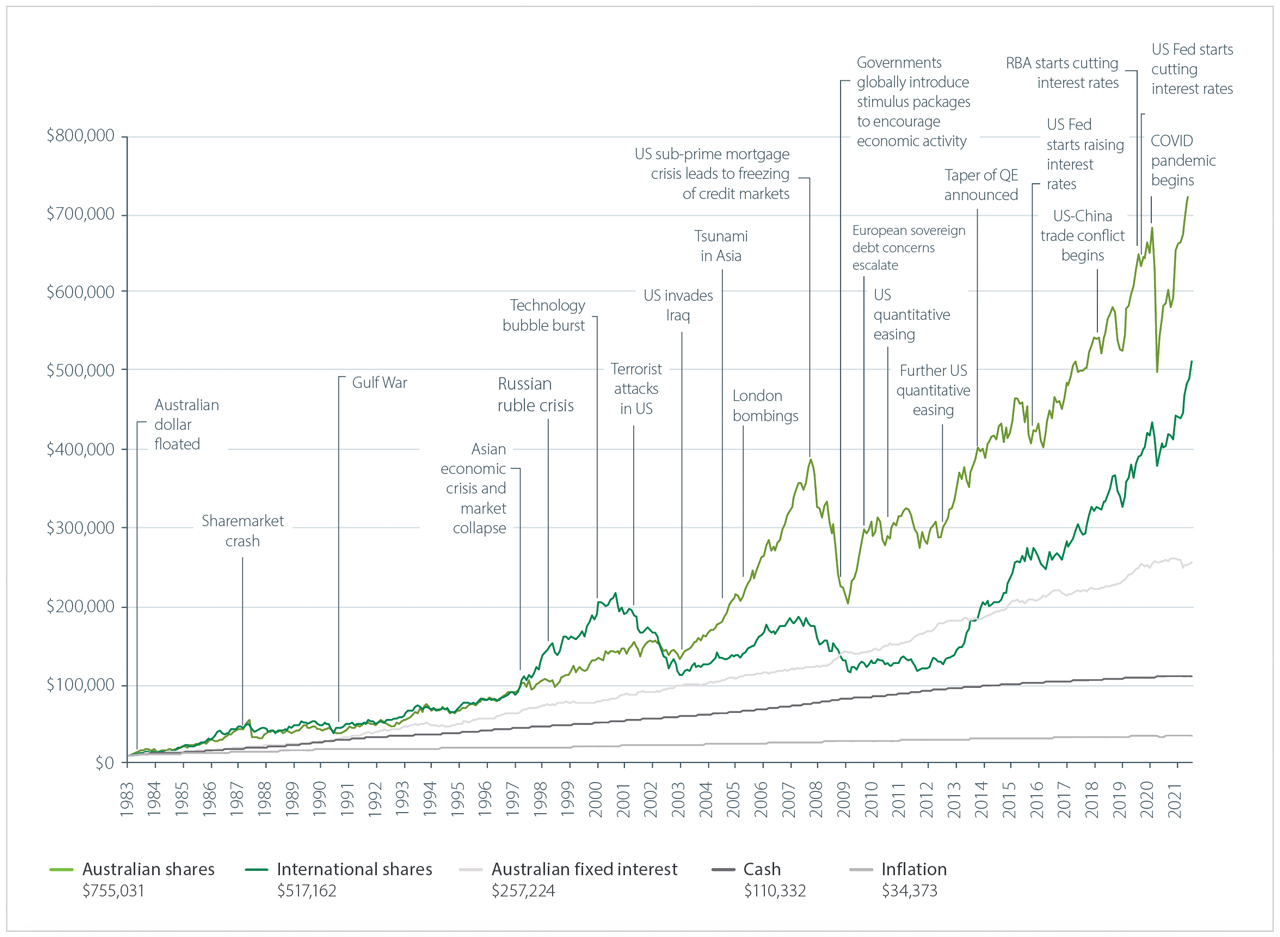
Growth of $10,000 invested over time#
^Timeframe: 1 July 1983 to 30 June 2021.
#Timeframe: 1 January 1983 to 30 June 2021. Past performance is not indicative of future performance. Your investment is subject to investment risk, including possible repayment delays and loss of income and capital invested. Any case study is shown for illustrative purposes only and is not a prediction of the actual outcomes you will achieve. Listed real assets and international fixed interest are not included in the graph above because data is not available from 1983.
Source: FactSet.
Data: Australian shares: S&P/ASX 300 Total Return Index | Global shares: MSCI World (ex Aust) Net Total Return Index in AUD | International listed property trusts: FTSE EPRA NAREIT (ex Aust) Total Return Index hedged to AUD | Australian fixed interest: Bloomberg AusBond Composite 0+ Years | International fixed interest: Bloomberg Barclays Global Aggregate hedged in AUD | Cash: Bloomberg Ausbond Bank Bill Index | Inflation: Consumer Price Index.
Note: Alternative assets do not have a standardised index so have not been included in the table or graph.
Important Information: This document is issued by MLC Investments Limited ABN 30 002 641 661 AFSL 230705 (MLCI). MLCI is part of the Insignia Financial Group of companies, comprised of Insignia Financial Ltd, ABN 49 100 103 722 and its related bodies corporate (Insignia Financial Group). This document contains factual information only and should not be relied on for decision making. This information in this document is based in part on information obtained in good faith from third party sources and is current as at September 2021. While this information is believed to be accurate and reliable at the time of publication, to the extent permitted by law, no liability is accepted for any loss or damage as a result of reliance upon it.

How much risk is right for you?
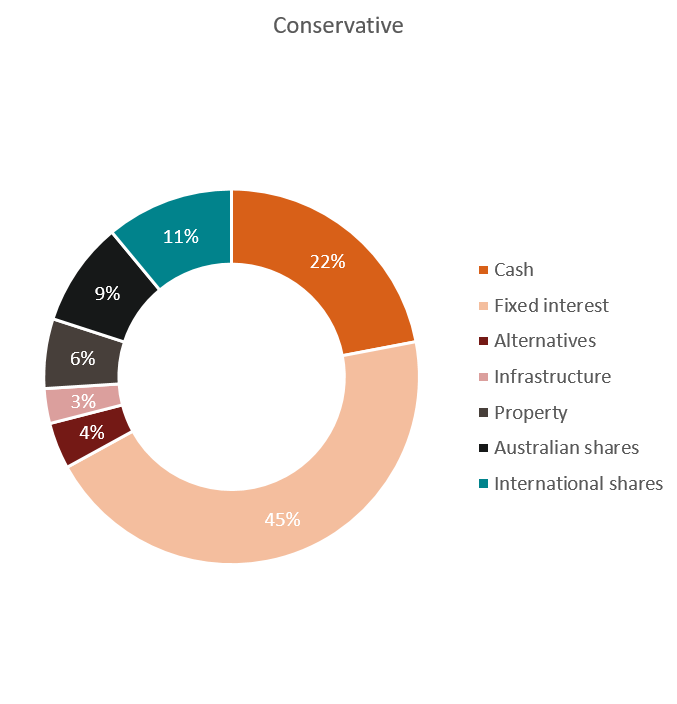
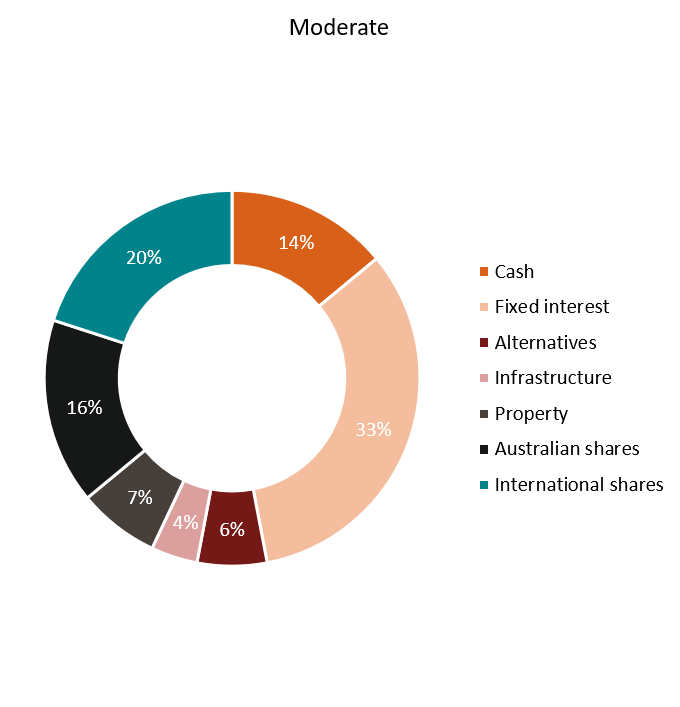
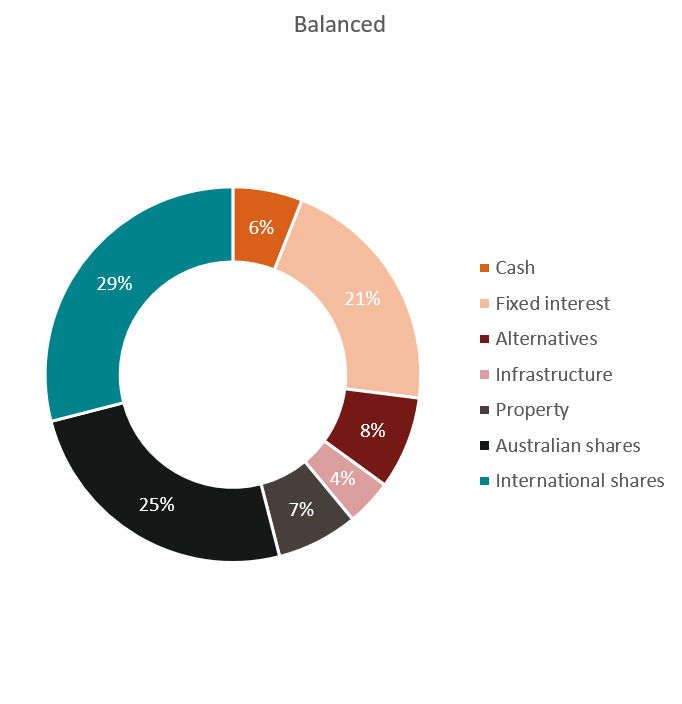
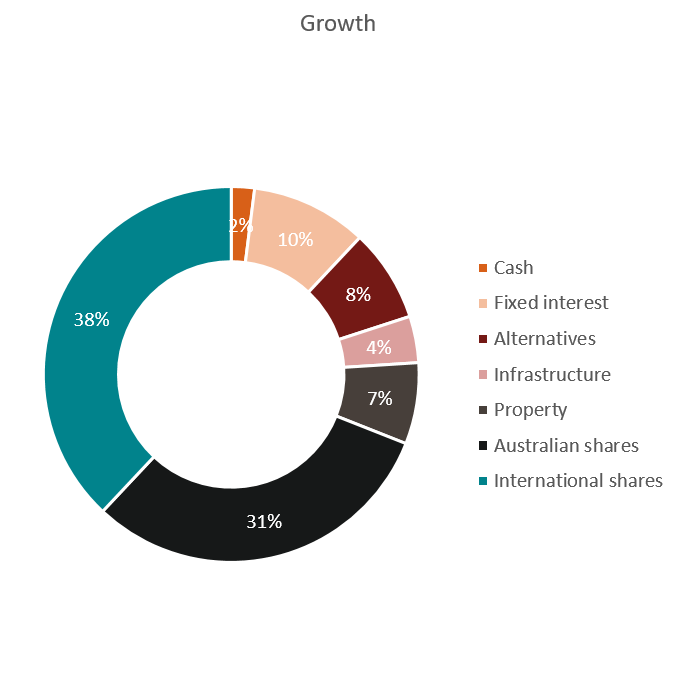
Part of any investment strategy involves determining the most appropriate asset allocation to meet your goals. The investment strategy that is most suitable for you is determined by a combination of factors, including your investor profile and your time horizon.
Different risk types
Please note these are sample profiles only of the MultiActive diversified funds – actual asset allocations may vary from fund to fund.
Diversified investment strategies
Growth of $10,000 over time*
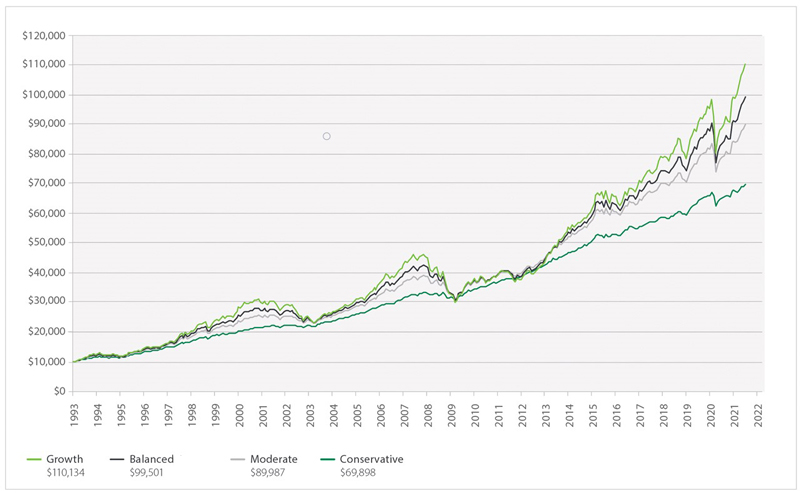
* Past performance is not indicative of future performance and the value of investments may rise or fall. This performance chart is based on our current strategic asset allocations and is for illustrative purposes only.
Risk and return characteristics
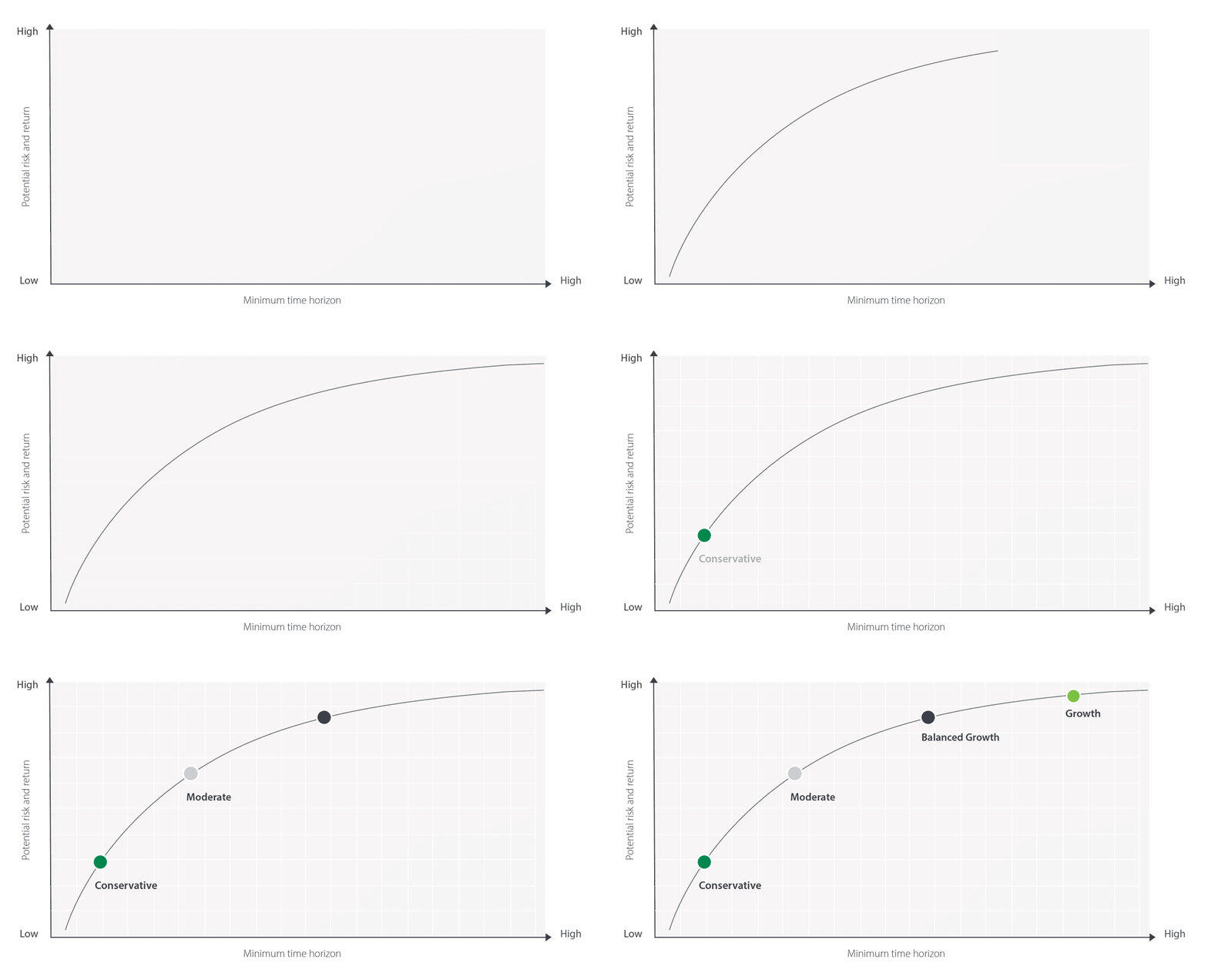
Timeframe: 1 January 1993 to 30 June 2021.
Source: FactSet.
Data: Australian shares: S&P/ASX 300 Total Return Index | Global shares: MSCI World (ex Aus) Net Total Return 30% Hedged to AUD | Listed real assets & unlisted assets: Pre 31/12/2005 MSCI World ex Australia Net Total Return 30% Hedged to AUD. Post 31/12/2005 50% FTSE EPRA/NAREIT Developed Rental Index ex Australia NR Hedged to AUD, 50% FTSE Developed Core Infrastructure 50/50 NR Hedged to AUD | Alternative growth: HFRI Fund of Fund Index, HFRI Fund of Fund Index Hedged to AUD from 31/12/2019 | Alternative defensive: Bloomberg AusBond Composite Bond Index 0-3 Years | Fixed interest: 50% Bloomberg AusBond Composite Bond Index 0+ Years and 50% Barclays Global Aggregate Hedged to AUD | Cash: Bloomberg Ausbond Bank Bill Index.
Important Information: This document is issued by MLC Investments Limited ABN 30 002 641 661 AFSL 230705 (MLCI). MLCI is part of the Insignia Financial Group of companies, comprised of Insignia Financial Ltd, ABN 49 100 103 722 and its related bodies corporate (Insignia Financial Group). This document contains factual information only and should not be relied on for decision making. This information in this document is based in part on information obtained in good faith from third party sources and is current as at September 2021. While this information is believed to be accurate and reliable at the time of publication, to the extent permitted by law, no liability is accepted for any loss or damage as a result of reliance upon it.
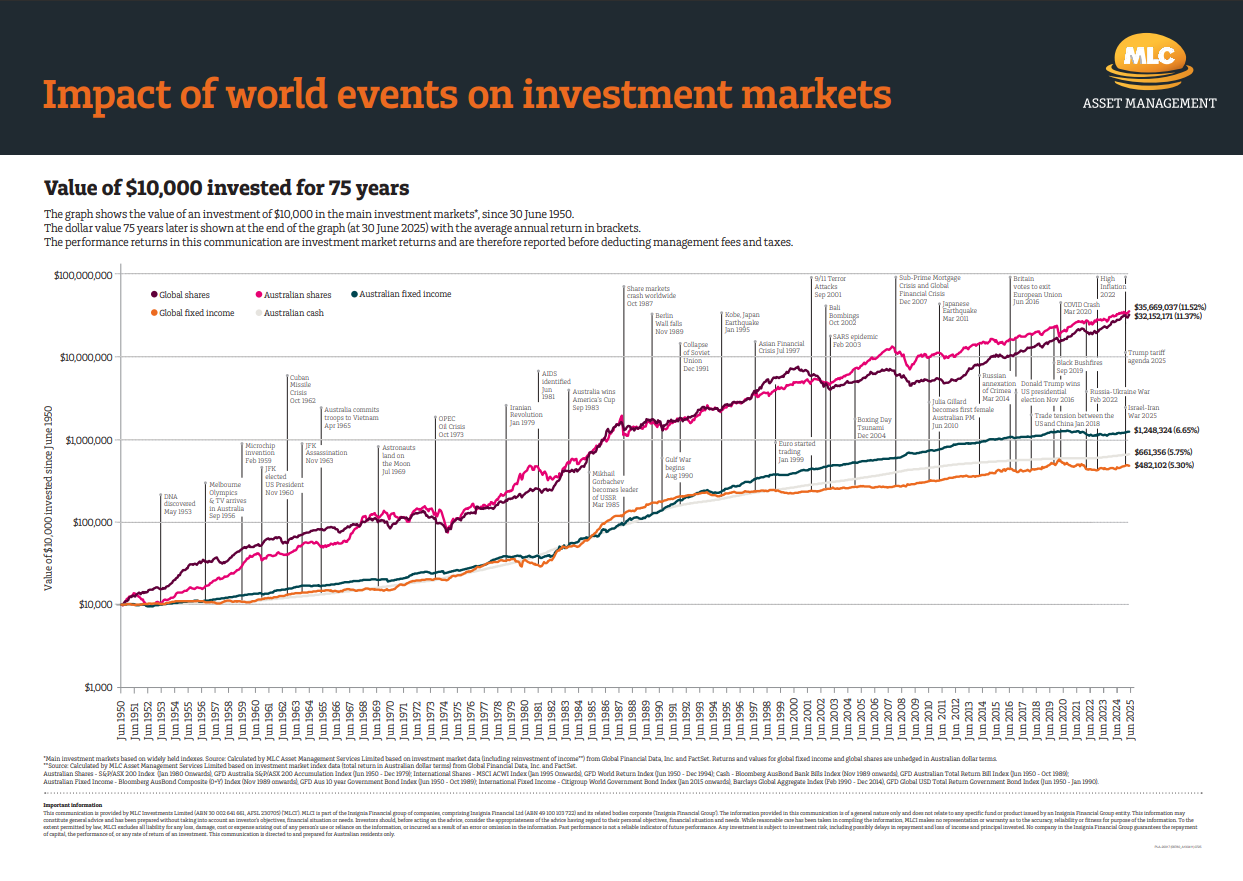
Impact of world events on investment markets
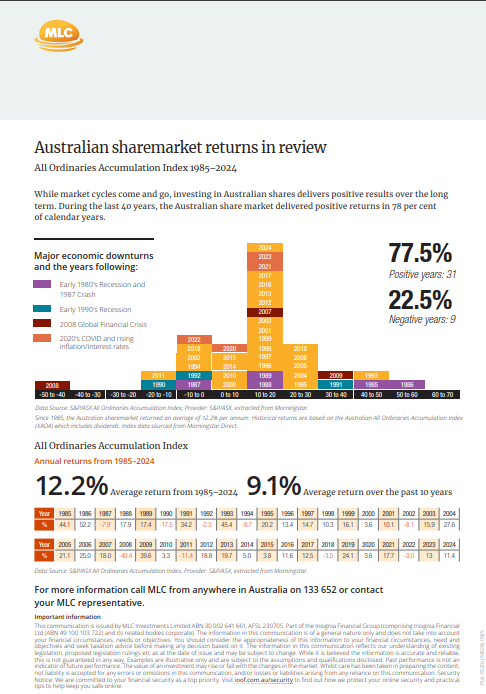
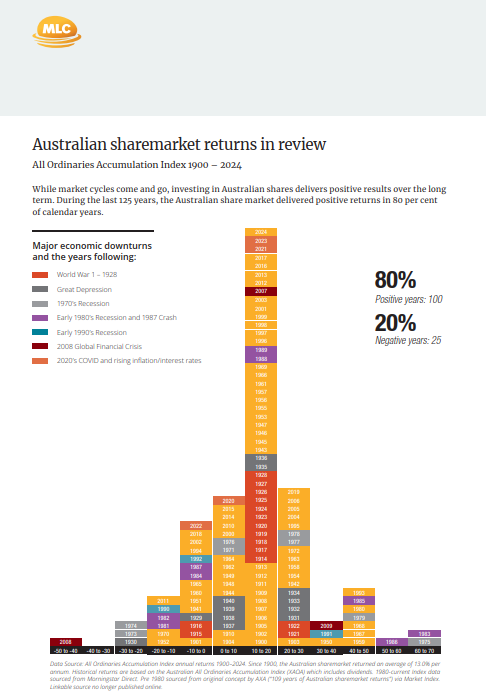
Explore Australian shares
While market cycles come and go, investing in Australian shares has consistently delivered positive returns over the long term. Historical data—spanning both 40 years and 125 years—shows the strength of long-term investing in Australian equities.
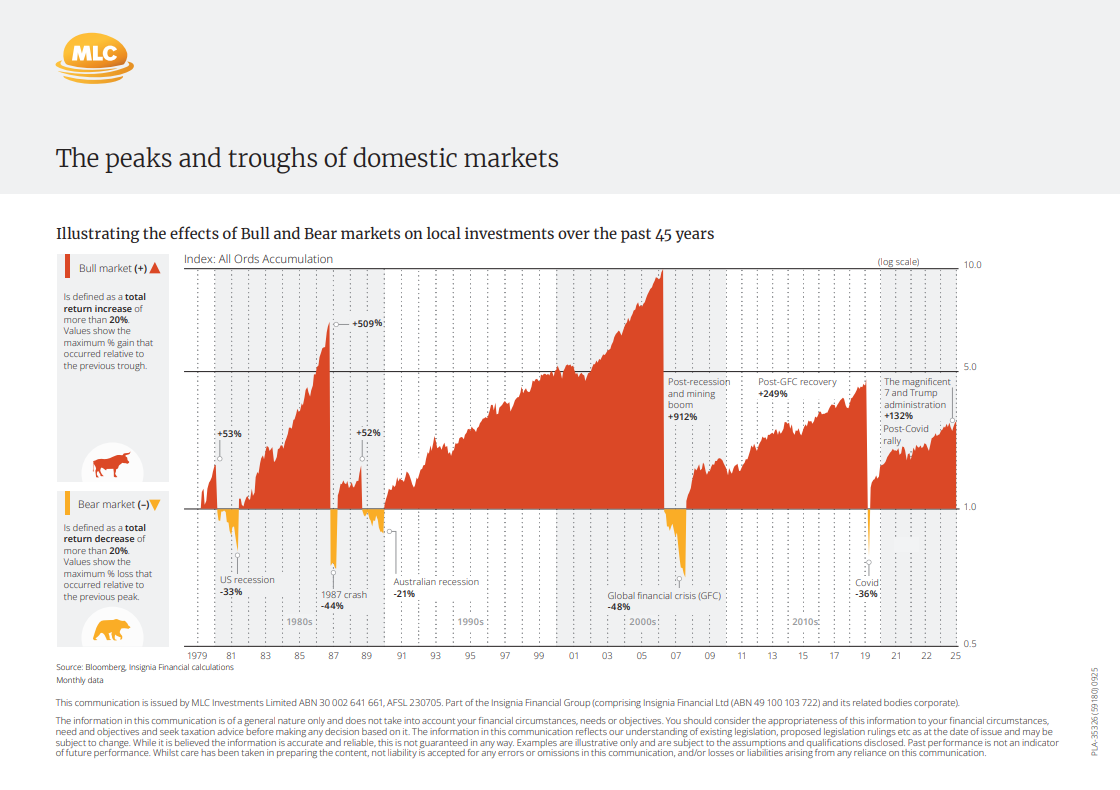
The peaks and troughs of domestic markets
Illustrating the effects of Bull and Bear markets on local investments over the past 45 years
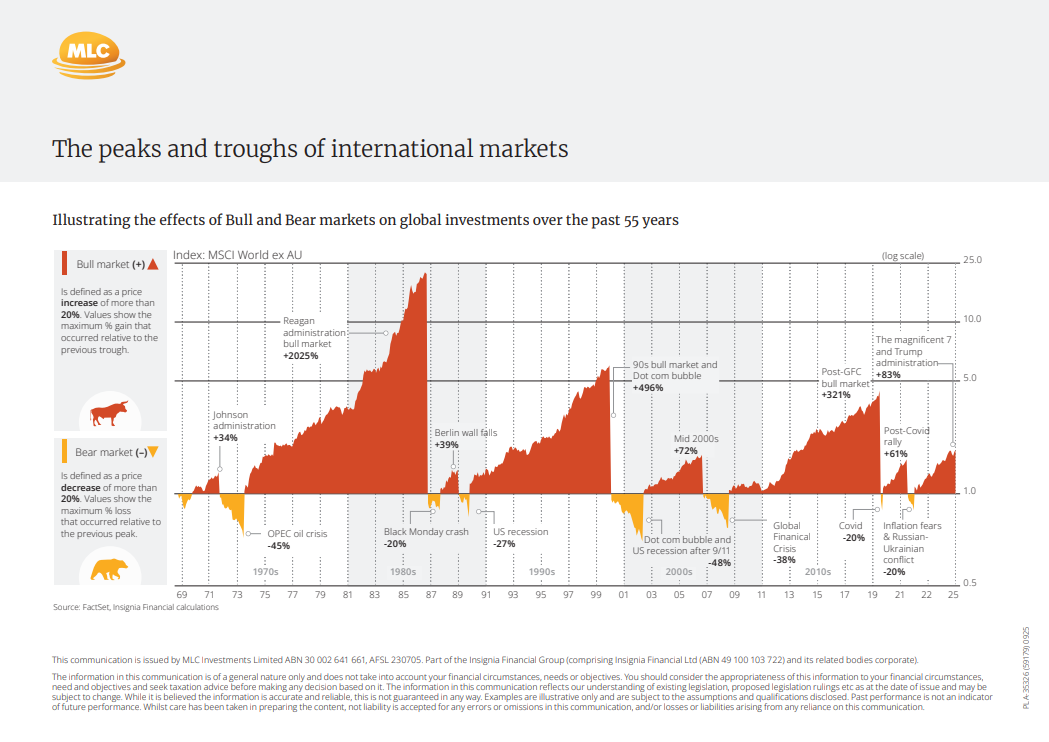
The peaks and troughs of international markets
Illustrating the effects of Bull and Bear markets on global investments over the past 55 years
Responsible Investment
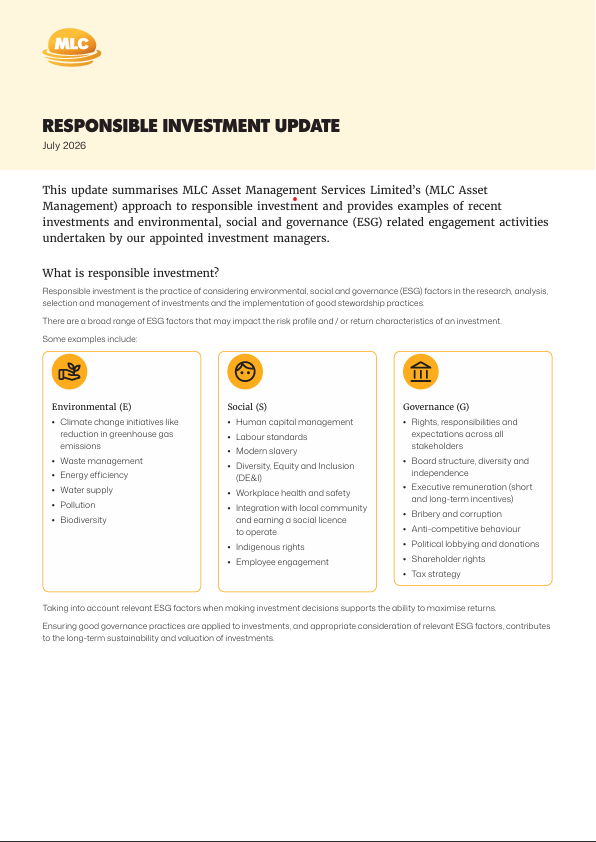
This update summarises MLC Asset Management Services Limited’s (MLC Asset Management) approach to responsible investment and provides examples of recent investments and environmental, social and governance (ESG) related engagement activities undertaken by our appointed investment managers.
What is responsible investment?
Responsible investment is the practice of considering environmental, social and governance (ESG) factors in the research, analysis, selection and management of investments and the implementation of good stewardship practices.
There are a broad range of ESG factors that may impact the risk profile and / or return characteristics of an investment.
Some examples include:
| Environmental (E) | Social (S) | Governance (G) |
|---|
| Climate change initiatives like reduction in greenhouse gas emissions | Human capital management | Rights, responsibilities and expectations across all stakeholders |
| Waste management | Labour standards | Board structure, diversity and independence |
| Energy efficiency | Modern slavery | Executive remuneration (short and long-term incentives) |
| Water supply | Diversity, Equity and Inclusion (DE&I) | Bribery and corruption |
| Pollution | Workplace health and safety | Anti-competitive behaviour |
| Biodiversity | Integration with local community and earning a social licence to operate | Political lobbying and donations |
| Indigenous rights | Shareholder rights |
| Employee engagement | Tax strategy |
Taking into account relevant ESG factors when making investment decisions supports the ability to maximise returns.
Ensuring good governance practices are applied to investments, and appropriate consideration of relevant ESG factors, contributes to the long-term sustainability and valuation of investments.
Responsible investment in the portfolios
Our Responsible Investment Statement defines the role Responsible Investment plays in the assessment, selection and monitoring process of externally appointed managers and outlines the framework for identifying and managing Environmental, Social and Governance (ESG) risks and opportunities across a number of Managed Investment Schemes.
Important information
This communication is provided by MLC Investments Limited (ABN 30 002 641 661, AFSL 230705) (MLCI). MLCI is part of the Insignia Financial Group of companies (comprising Insignia Financial Ltd, ABN 49 100 103 722 and its related bodies corporate) ('Insignia Financial Group'). An investment with MLCI does not represent a deposit or liability of, and is not guaranteed by, the Insignia Financial Group.
This information may constitute general advice. It has been prepared without taking account of an investor's objectives, financial situation or needs and because of that an investor should, before acting on the advice, consider the appropriateness of the advice having regard to their personal objectives, financial situation and needs. Past performance is not a reliable indicator of future performance. Share market returns are all in local currency. Any opinions expressed in this communication constitute our judgement at the time of issue and are subject to change. We believe that the information contained in this communication is correct and that any estimates, opinions, conclusions or recommendations are reasonably held or made as at the time of compilation. However, no warranty is made as to their accuracy or reliability (which may change without notice), or other information contained in this communication.
This information is directed to and prepared for Australian residents only.
MLCI may use the services of any member of the Insignia Financial Group where it makes good business sense to do so and will benefit customers. Amounts paid for these services are always negotiated on an arm's length basis. MLCI rely on third parties to provide certain information and is not responsible for its accuracy, nor is MLCI liable for any loss arising from a person relying on information provided by third parties. Bloomberg Finance L.P. and its affiliates (collectively, "Bloomberg") do not approve or endorse any information included in this material and disclaim all liability for any loss or damage of any kind arising out of the use of all or any part of this material.
The funds referred to herein is not sponsored, endorsed, or promoted by MSCI, and neither MSCI bear liability with respect to any such funds.
Investment philosophy
These beliefs guide our decision making and are central to how we construct our portfolios and bring the best of our investment thinking to our clients.
We believe:
- a great culture is the foundation for great investing
- active management adds value
- skilful diversification delivers over the long-term
- intelligent risk taking is a must
- the long-term matters but we remain agile
Our Chief Investment Officer, Dan Farmer, explains our Investment Philosophy.
MLC managed account strategies
Our unified team has had a long association with creating and managing multi-manager portfolios for investors and draws on the very best of our individual corporate heritages, honed over multiple investment cycles. We have created an investment capability of significant depth and breadth in the industry – leveraging a powerful common engine room working for the benefit of our clients.

Dan Farmer
CHIEF INVESTMENT OFFICER
B.Ec (Hons), M.Com (Hons)
Dan was appointed to the role of Chief Investment Officer (CIO) in July 2022, a position that brought together MLC AM and IOOF investment teams under his leadership. In this role, Dan is focussed on the group’s multi-asset strategies and he is responsible for management of the team, overall investment performance, managing risk and delivering superior investment outcomes to investors. He is also a member of the Investment Management Committee. Together with the single asset class strategies the broader Investment team manages ~$97 billion.
Prior to this role, Dan led the investment team managing IOOF’s funds from 2017-2022 and before this he managed the Australian Equities portfolio for seven years, successfully implementing the boutique program and defensive equities portfolio in this time.
Before this, Dan was Senior Executive Investments at Telstra Super, managing the fund’s $3 billion Australian equity portfolio for seven years. During this period Telstra Super’s Australian equity product consistently ranked highly in the SuperRatings performance survey. Dan was also Portfolio Manager responsible for day to day management of internally managed Australian share portfolios at Telstra Super totalling over $450 million.
Dan holds a Bachelor of Economics (Honours) from La Trobe University in Melbourne and a Master of Commerce (Honours) from the University of Melbourne.
Dr Ben McCaw
JOINT HEAD OF CAPITAL MARKETS RESEARCH
Ben is co-head of MLC’s Capital Markets research team where he shares portfolio management responsibility for several of MLC’s diversified funds, SMAs and direct investment strategies.
Ben joined MLC in 2008 after working as an equity analyst in Singapore and Sydney where he focussed on small and emerging healthcare companies.
Ben holds a Master of Applied Finance from the University of Adelaide as well as a PhD in Genetic and Bioinformatics at The Walter and Eliza Hall Institute of Medical Research from the University of Melbourne.
Grant Mizens OAM
JOINT HEAD OF CAPITAL MARKETS RESEARCH
Grant is a Portfolio Manager in the Capital Markets Research team responsible for asset allocation across MLC’s diversified portfolios. He re-joined the team in 2014 and is involved in the team's asset allocation work, including scenarios and asset class modelling.
Grant has worked at MLC Asset Management since 2006. His main focus has been portfolio construction and manager research for MLC's equity portfolios. Before re-joining the Capital Markets Research team he was a Senior Consultant in the JANA Advice and Research Team.
Grant has a BA (Econ) from the University of Illinois and a Diploma of Financial Management from Finsia.

Steven Gamerov
HEAD OF DIVERSIFIED PORTFOLIO MANAGEMENT (DEFAULT)
MBusSc
Steven is responsible for the construction and ongoing management of the diversified portfolios of MLC Superfund to ensure superior performance that is in line with client investment objectives.
Previously Steven was Head of Asset Consulting for Implemented Consulting clients at JANA, joining from MLC Implemented Consulting in March 2012. Steven is a qualified actuary and has over 25 years’ experience in the industry across asset consulting, investment research and portfolio management.
Steven commenced his career in South Africa where he was Director of Investment Consulting at Fifth Quadrant Actuaries & Consultants. He has held several senior positions in the investment industry in Australia including Head of Investment Solutions at St George Bank, Senior Consultant at Intech Asset Consulting, and Senior Portfolio Specialist at MIR Investment Management.
Steven has a MBusSc majoring in Economics and Statistics and is a Fellow of the Faculty of Actuaries.

Stanley Yeo
HEAD OF STRATEGY AND EQUITIES
B.Com, LLB (Hons), CFA
Stanley has been employed by Insignia Financial since September 2010. Stanley was appointed to the role of Deputy Chief Investment Officer in July 2017 and Head of Equities in June 2020 and is responsible for managing a team of portfolio managers and analysts responsible for Australian and International Equities.
Prior to this he was the Portfolio Manager for Strategy and International Equities responsible for strategy and asset allocation of the diversified products of the IOOF multi-manager funds, and also managed the International Equities portfolio. He also previously managed the Fixed Interest and Cash portfolios.
Stanley holds a Bachelor of Laws (Hons), a Bachelor of Commerce and is a Chartered Financial Analyst. Prior to joining the investment team, Stanley was a Senior Consultant at Russell Investments. He has advised on strategic asset allocation, portfolio construction and implementation to large Asian sovereign wealth funds and large corporate superannuation funds. He actively managed and implemented the strategic asset allocation of the BHP Billiton Superannuation Fund to achieve consistent first quartile returns. Prior to this role, Stanley was an Investment Analyst at Gartmore Investment, UK. Outside of work, Stanley has a keen interest in travel and food.
Osvaldo Acosta
HEAD OF FIXED INTEREST ASSETS
B.Bus, M.Com
Osvaldo joined the IOOF Investment Team in December 2016 as Portfolio Manager Fixed Income and is currently the Head of Fixed Interest Assets responsible for portfolio management and performance of the various fixed income portfolios at IOOF. He has over 19 years industry experience within fixed income and capital markets.
Prior to joining Insignia Financial, Osvaldo worked at Western Asset Management, a specialised global fixed income manager, where he was part of the investment management team responsible for portfolio management, trading and implementation of interest rate strategies across a number portfolios, including traditional fixed income, specialist credit, annuity matching funds, global mandates and cash/cash enhanced.
Prior to Western Asset Management, Osvaldo also held various senior roles in fixed income, treasury and capital markets within major Australian corporates.
Gareth Abley
CO-HEAD OF ALTERNATIVE STRATEGIES
From 1998 to 2002, Gareth was a manager research analyst with Skandia UK focusing on equities, fixed interest and diversified portfolios. In 2002, he joined MLC as an asset consultant and later became Head of Asset Consulting. In this role he led a team which was responsible for advising a diverse range of institutional clients (including super funds, charities, endowments and health insurers) on their investment strategies. Gareth is currently Head of Alternative Strategies, where he is responsible for evolving MLC’s alternatives capabilities and is co-PM (with Jehan Sukhla) of the Low Correlation Strategy, which was created in 2008. The strategy was the winner of the ‘Multi-Strategy Hedge Fund of the Year Award’ in 2014.
Jehan Sukhla
CO-HEAD OF ALTERNATIVE STRATEGIES
B.Acc, CFA, GAICD
Jehan has been actively engaged in investment management since 2001, coordinating manager research and portfolio construction of multi-manager portfolios across several asset classes. From 2001 to 2003, Jehan was a Graduate at BT Funds Management. He joined MLC Investment Management in 2003 as a Research Analyst focusing on fixed income and currency portfolios. In 2005 his responsibilities expanded to include coverage of alternative strategies and commodities, overseeing total assets/overlays of A$30bn. Since 2010 he has focused exclusively on MLC/Insignia’s Alternative Strategies, and is Co-PM for MOGS and IRIs.
Marek Herchel
HEAD OF PRIVATE EQUITY US
Marek joined MLC Private Equity in early 2017 and leads its private equity investment activities across the United States and Europe. He currently represents MLC’s private equity investments on numerous advisory and corporate boards. Marek has over 20 years of investment and business leadership experience in private equity. He has invested over US$14 billion across 200+ private equity investments globally and served on over 100 advisory and corporate boards.
Prior to joining MLC, Marek spent 13 years at AlpInvest Partners, most recently as Managing Director leading the Primary Fund Investments team across the Americas and a member of its global Investment Committee. Marek received a BS in Business Administration and a MS in Finance, both summa cum laude, from Suffolk University in Boston.

James Tayler
HEAD OF RESPONSIBLE INVESTING
James was appointed Head of Responsible Investing in June 2022. In this role he is accountable for facilitating a high quality and constantly evolving Responsible Investing strategy across all investment capabilities. He is focussed on driving the development and articulation of our position in key areas such as identifying and managing ESG risks and opportunities, maximising the effectiveness of engagement with managers and companies, and also has a strong focus on climate change, modern slavery, and governance. His role is also integral in helping the organisation improve the way it communicates its responsible investment actions.
Previously, James was Head of ESG at Ellerston Capital, a listed equity-focused investment boutique. Prior to relocating to Australia in 2016, James held various investment management roles in London, UK, and Zurich, Switzerland, representing a 20-year career in listed equity investment primarily including security analysis and portfolio management responsibilities.

Anthony Golowenko
PORTFOLIO MANAGER
Anthony joined MLC Asset Management’s multi-asset Capital Markets Research team in February 2021.
He has 21 years investment experience and is passionate about developing and managing innovative solutions aligned with investor objectives and helping everyday Australians secure their investment journey.
Anthony joins MLCAM from Australian boutique Clime Investment Management, where had overall responsibility for Clime’s investment team, strategies and performance outcomes. Here Anthony launched a suite of objective based SMA model portfolios.
He has held previous roles at State Street Global Advisors including Senior Portfolio Strategist – Asia Pacific, Head of Active Australian Equities and Senior Portfolio Manager. He has significant experience in domestic and international equities, return enhancing and risk reducing overlays and objective based strategy development.
Anthony holds a Bachelor of Mathematics and Finance degree with First Class Honours from the University of Technology, Sydney, and is a CFA charterholder. He is involved in the community supporting Sylvanvale Disability Services and Tour de Cure.

Liam Wilson
PORTFOLIO MANAGER
CIMA, B.Comm, M.AppFin
Liam is joined Insignia Financial in 2020 and is the Portfolio Manager for the OptiMix and OnePath diversified portfolios, as well as global equities, REITs and listed infrastructure portfolios. This involves setting investment strategy, selection of fund managers, portfolio construction and implementing asset allocation tilts for the multi-asset portfolios.
Prior to Insignia Financial, Liam held portfolio management responsibilities for Australian equities, global and emerging markets, and fixed income portfolios at ANZ Wealth. Previous to this, Liam was responsible for Australian equity fund manager research and market analysis, as well as research, development and implementation of the ING Investment Management (INGIM) overlay strategies within the Australian equities multi-manager portfolios.
Liam has over 17 years of financial market experience, commencing his career with the global investment research house Morningstar, where he worked as a performance analyst, focusing on portfolio performance analytics and ratings.
Liam holds a Bachelor of Commerce (majoring in Finance and Economics) from the University of Wollongong, and a Master of Applied Finance from Macquarie University. Liam is also a Certified Investment Management Analyst from the Investment Management Consultants Association.
Peter Sumner
PORTFOLIO MANAGER
Peter joined MLC in 1989, to assist in the management and development of cash, short term and fixed interest strategies. In 2008, he became the Portfolio Manager for Australia Equity and Property Funds. Peter has strong manager research capabilities across equities, REITs and fixed income asset classes. Peter holds a B. Bus., ASIA, M. Bus (Finance).

Mark Nordio
SENIOR MANAGER FIXED INTEREST ASSETS AND STRATEGY
B.Comm (Hons), B.Sc
Mark joined Insignia Financial in 2020 and is responsible for portfolio construction and manager selection for Australian and global fixed income and cash. Prior to Insignia Financial Mark worked at ANZ/OnePath in a similar role.
Mark brings to the role over 20 years of Australian and global fixed income portfolio management experience, gained at some of the leading investment houses in Australia, namely County NatWest Investment Management Ltd (3 years), Barclays Global Investors (12 years), BlackRock (2 years) and Antares Fixed Income (5 years). More recently Mark designed the strategic asset allocation and selected the managers for the diversified fixed interest option for CommInsure.
Mark holds a Bachelor of Commerce (Honours) from the University of Melbourne (majoring in Econometrics and Economics) and a Bachelor of Science also from the University of Melbourne (majoring in Statistics and Operations Research).

David Chan
PORTFOLIO MANAGER
David joined MLC in 2009 as Head of Asia, MLC Private Equity. His extensive industry experience, spanning over 20 years, includes corporate strategy, strategic due diligence, M&A, IT strategy, operational implementation, product design, financial modelling and process improvement. During his tenure at MLC, David has led coverage of Asian and EM companies and, while currently based in Sydney, he has also worked out of NY and London covering investments in Nth America and the UK.
He has worked closely with the many of the largest banks in Australia and Europe to implement their Asia and China entry strategies, including both M&A and greenfield branch expansion, where he was operationally involved in recruitment, process design and key governance aspects. David started his career as a software engineer and system architect, working several high-profile organisations (e.g. Yahoo, Sun Microsystems, NRMA) on pioneering web applications and search engine technology. David has also gained a particular knowledge of the Asian financial services, being one of the most qualified experts in that sector.
David was placed first in both his Master of Commerce (Finance) and Bachelor of Software Engineering (First Class Honours and University Medal) degrees from the University of New South Wales. He achieved a UAI of 100, ranking first in the State. He is also a CFA charterholder and sits on the Infrastructure Investment Committee for MLC.

Rachael Lockyer
PORTFOLIO MANAGER
Rachael joined MLC Private Equity in 2021 with a focus on co-investments and Australian manager relationships, bringing 16 years of investment management and investment banking experience in Australia, Asia, the US and New Zealand. Rachael has broad and deep investment experience, having worked throughout the private equity value chain.
Prior to joining MLC Rachael managed buyout investments at global consumer private equity fund L Catterton where she reviewed and appraised numerous private equity investment opportunities, and worked closely with founders and management teams to scale businesses either organically or via acquisitions, including leading the international expansion of portfolio companies and the establishment of high growth divisions.
She was also an Associate Director at Australian mid-market private equity fund Ironbridge Capital. Rachael is a graduate of the Australian Institute of Company Directors (GAICD) and holds Commerce and Law degrees from the University of Auckland.
Laura Hotaling
PORTFOLIO MANAGER
Laura Hotaling joined MLC Asset Management’s private equity team as a portfolio manager in September 2021.
Ms Hotaling brings 14 years of investment management experience across private as well as listed markets. Her focus at MLC Asset Management is manager coverage for the US and Europe, and origination, execution and management of private equity funds and execution of co-investments.
Most recently Ms Hotaling was the Chief Risk Officer at New York State Teachers’ Retirement System (NYSTRS) and before that was NYSTRS’ Manager of Private Equity – International. Earlier in her career Ms Hotaling was Equity Research Analyst with Paradigm Capital Management and Private Equity Associate with LGT Capital Partners, both in New York.
She holds a Bachelor of Science in Economics from The Wharton School, University of Pennsylvania.
Kerry Gill
FUND STRATEGIST
BCom/BSc, MEc
Kerry is a long standing MLC investment professional, having joined the Capital Markets Research team in May 2005 as an Investment Analyst. She subsequently became a Senior Investment Analyst, Assistant Portfolio Manager, and was then promoted to Fund Strategist in 2021. Kerry’s key responsibilities include the asset allocation and strategic focus of the MLC retail multi-asset portfolios.
Prior to joining, Kerry worked for the NSW Government as an economic analyst in the Revenue Strategy division of NSW Treasury and as an economist focused on Sydney metropolitan water pricing at the Independent Pricing and Regulatory Tribunal of NSW.
Kerry has a Bachelor of Commerce (Finance) and a Bachelor of Science (Mathematics) from the University of New South Wales and a Master of Economics from Macquarie University.
Bob Cunneen
SENIOR ECONOMIST AND PORTFOLIO SPECIALIST
Bob Cunneen joined MLC Asset Management in April 2016 in the role of Senior Economist and Portfolio Specialist.
Bob has 30 years' experience in global financial markets covering asset allocation, bond strategy and currency management.
Bob has respective Master's degrees in Economics and Finance and is a graduate of London, Macquarie and Sydney University.